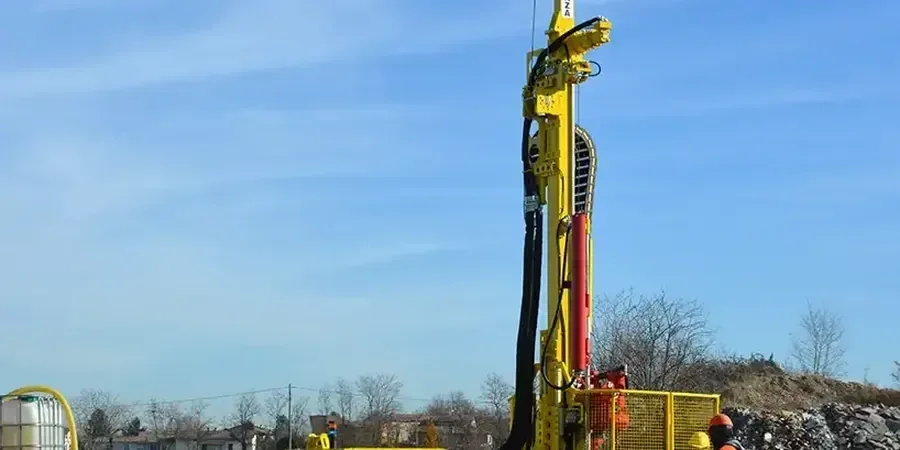
ASTM D1586 governs the Standard Penetration Test (SPT) and remains the backbone of subsurface investigation for Orlando projects, where sandy surficial soils overlying limestone create a specific set of design conditions. The Florida Building Code, which incorporates IBC Chapter 18, requires adequate soil borings with SPT data before any commercial or multi-family foundation design can proceed. Orlando sits at roughly 82 feet above sea level on the Orange County Ridge, an area where Pleistocene sands can extend 30 to 60 feet deep before encountering the Hawthorne Formation or weathered limestone. In our experience, this stratigraphy makes SPT blow counts particularly useful for distinguishing loose, potentially compressible sand layers from the denser materials that provide reliable bearing capacity. We run our SPT program with calibrated automatic trip hammers and report N-values referenced to the energy correction standard, which ensures the data can be used directly by structural engineers who need to apply liquefaction assessments or settlement calculations per liquefaction analysis protocols required in central Florida.
SPT blow counts in Orlando's sandy overburden are the primary indicator for distinguishing stable ground from zones that need Improvement or deeper foundations.
Regional considerations
Central Florida's geology presents a risk profile that differs sharply from regions with deep alluvial basins: we are not dealing with thick soft clays, but rather with variable sand density, shallow groundwater, and the ever-present possibility of karst features. Sinkhole activity in Orange County is well documented, and while a catastrophic collapse is rare, raveling zones where sands migrate into limestone voids can produce erratic SPT blow counts that drop suddenly at depth. A boring that shows N-values of 22, 24, and then 5 over a 10-foot interval demands attention. We have seen this pattern near the Pine Hills area and along sections of Semoran Boulevard, where the contact between the sand mantle and the underlying limestone is highly irregular. Running SPT borings at closer spacing in these karst-sensitive zones, combined with seismic-refraction geophysical profiling, gives us a more complete picture of subsurface anomalies before the structural engineer commits to a foundation type.
Top questions
How many SPT borings does the City of Orlando require for a commercial building permit?
The Florida Building Code references IBC Table 1803.1, which generally requires at least one boring per 2,500 square feet of building footprint for structures up to 5,000 square feet. For larger buildings, the spacing guideline is one boring per 5,000 square feet, with a minimum of two borings for any commercial structure. Orlando's building department reviews the geotechnical report as part of the permit package, and the geotechnical engineer of record determines final boring layout based on site geology and structural loads.
What is the typical cost range for SPT testing at a standard Orlando residential lot?
For a single-family home site in the Orlando area with two borings to 20 feet depth, the SPT investigation typically falls between US$610 and US$660 per boring, which includes mobilization, drilling, N-value recording, groundwater observation, and a signed geotechnical report with bearing capacity recommendations. Sites requiring ATV rigs for limited backyard access or deeper borings for pool foundations may see adjusted pricing based on specific conditions.
How do you handle groundwater in SPT borings around Orlando's lakes and wetlands?
We record the groundwater level at the time of drilling and then return 24 hours later for a stabilized reading in each borehole. In areas near Lake Apopka or the Butler Chain of Lakes where the water table is consistently high, we use hollow-stem augers to keep the hole open and prevent sand heave during sampling. The stabilized water level is reported on every boring log and directly influences the effective stress calculations the structural engineer uses for bearing capacity and settlement analysis.
Can SPT data from Orlando sites be used for liquefaction analysis?
Yes, and it is a standard part of our reporting for larger commercial projects. We apply NCEER (Youd and Idriss) correction factors to the raw N-values to obtain N1(60) values that feed into the cyclic stress ratio and cyclic resistance ratio calculations. Although Orlando is not in a high-seismicity zone like the West Coast, the design ground motions specified by ASCE 7 for the region still require a liquefaction screening when loose saturated sands are present within the upper 50 feet of the profile.