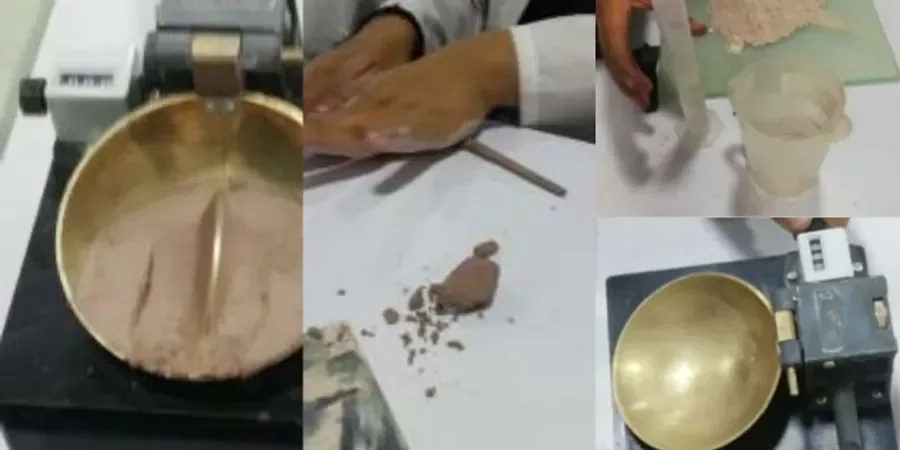
Orlando's expansion from a citrus and cattle hub into a major metropolitan area brought construction onto soils that weren't always straightforward. The city sits on a mix of Pleistocene sands, silty sands, and pockets of clay derived from weathered limestone—materials that can change behavior dramatically with just a few percent difference in moisture. When a contractor calls us after hitting unexpected fat clay in a retention pond excavation off Narcoossee Road, the first lab test we order is Atterberg limits. It tells us immediately how plastic the material is and whether it will swell, shrink, or lose strength under Orlando's intense summer rain cycles. For road subgrades near the Wekiva basin or foundation pads on the east side where the Hawthorn Group clays appear, knowing the liquid limit and plasticity index isn't optional—it's what separates a stable section from a future claim. We pair the Atterberg data with grain-size analysis when the fines content is high, and we often run Proctor compaction tests on the same sample to lock in the moisture-density relationship before the first lift goes down.
A plasticity index above 15 in Orlando's Hawthorn Group clays means you need to account for swell potential—not after the slab cracks, but before the concrete is ordered.
Regional considerations
The Hawthorn Group sediments underlying much of east and south Orlando contain smectite-rich clays that can produce plasticity indices exceeding 30. These soils undergo significant volume change with seasonal moisture fluctuation—Orlando receives over 50 inches of rainfall annually, concentrated in June through September, followed by a distinct dry season. A foundation bearing on such material without a properly classified PI can experience differential heave. The Florida Building Code (2023 edition, section 1803) requires Atterberg limits on fine-grained foundation soils specifically to assess this risk. Our lab has processed thousands of samples from Orlando job sites, and we flag any PI above 15 for the geotechnical engineer's attention. If the natural moisture content is already near the plastic limit at the time of sampling, the soil has little capacity to absorb additional water without deforming. That's the kind of site-specific detail that a generic soil description will never catch, and it's why we run Atterberg limits on every boring that encounters cohesive material below the water table.
Standards that apply
ASTM D4318-17e1: Standard Test Methods for Liquid Limit, Plastic Limit, and Plasticity Index of Soils, ASTM D2487-17e1: Standard Practice for Classification of Soils for Engineering Purposes (Unified Soil Classification System), Florida Building Code 2023, Chapter 18: Soils and Foundations, AASHTO T 89 and T 90: Determining the Liquid Limit and Plastic Limit of Soils
Top questions
How much does Atterberg limits testing cost in Orlando?
A standard suite (liquid limit, plastic limit, plasticity index, and natural moisture content) runs between US$60 and US$100 per sample depending on volume and turnaround. Rush processing is available for an additional fee. We'll quote your specific project once we know the number of samples and whether you need companion tests like grain-size or Proctor.
How long does the test take from sample drop-off to report?
Standard turnaround is 24 to 48 hours. We can deliver same-day results for a limited number of samples if they arrive before 10 a.m. and you request rush service. The drying and preparation steps require a minimum of several hours, so we never cut corners on specimen conditioning.
Why do I need Atterberg limits if I already have a grain-size analysis?
Grain-size tells you the particle distribution; Atterberg limits tell you how the fine fraction behaves with water. Two soils can have identical silt and clay percentages but completely different plasticity. A silt with PI near zero will drain and compact easily; a fat clay with PI above 25 will hold water, swell, and require treatment. Both numbers matter for subgrade design.
Can you test samples from retention pond excavations and wet borrow sources?
Yes. We run Atterberg limits on wet, organic, and high-plasticity materials routinely. If the sample arrives saturated, we dry it per ASTM D4318 before testing. For pond liners, we'll report the PI alongside the natural moisture to help the engineer assess whether the material can serve as a low-permeability barrier.